
HSBC forecasts Vietnam's GDP growth to hit 6.7 per cent in 2026

 |
While 2025 was a rollercoaster year for Vietnam, it defied tariff concerns with yearly growth as high as 8 per cent, in line with HSBC's expectations. This will easily place Vietnam as the growth champion in Asia. Although Vietnam was widely expected to be one of the economies with high tariff risks, its trade ballooned to a record high instead. Its trade surplus also remains sizeable. Despite facing a 20 per cent headline tariff from the US, Vietnam captured even more market share for certain goods, such as footwear, textiles, and consumer electronics.
Entering 2026, many may wonder how sustainable Vietnam's trade is, and when the trade pay-back will arrive. Vietnam is no exception to a potential global trade pull-back, but HSBC believes its exports of the 'right' products (ie electronics) amid AI-driven demand and widening market share in the US are likely to shield it from some trade headwinds. In addition, HSBC expects the emphasis on infrastructure development to continue in the new year, accelerating key mega projects and lifting growth. Overall, Vietnam's GDP growth is expected to hit 6.7 per cent in 2026.
Vietnam will start 2026 with a key political event. The 14th National Congress of the Communist Party of Vietnam (CPV), which is scheduled to take place from January 19-25. The National Congress, held every five years, will choose the country's new leadership and set socioeconomic goals for the next five to 10 years.
All eyes will be on who the next 'five pillars' will be, specifically who will fill the top five positions: Party General Secretary, state president, prime minister (PM), chair of the National Assembly and standing member of the Secretariat. The last position was added to the top leadership line up only last September, marking a shift from 'four pillars' to 'five pillars'.
That said, regardless of the outcome of the leadership reshuffle, economic policy is widely expected to be consistent and unlikely to change significantly.
In each congress session, key economic goals, including GDP growth and GDP per capita for the next five years will be revealed. Vietnam's 2021-25 average GDP growth reached 6.2 per cent, missing its target of 6.5-7 per cent growth set in the five-year socioeconomic development plan for the period, but this was due only to the slow growth in the pandemic-hit 2021. Over the medium term, Vietnam is striving to become an upper-middle income country by 2030 and ultimately a high-income one by 2045.
In November 2025, a series of targets for 2026 were approved by the National Assembly, providing a peak of what to expect for the 2026-30 period. The 2026 growth target is set at “at least 10 per cent” with GDP per capita of $5,400-5,500. Note that the double-digit growth target is on top of the high GDP growth of 8 per cent last year, requiring a hard push to achieve broad-based growth, including trade outperformance, significant investments, and strong consumption.
What reforms will be introduced to support growth are also key to watch. Vietnam has pushed for a series of reforms, with the reorganisation of state agencies and the merging of provinces and cities being the main highlights of 2025, to reduce hurdles and streamline administrative processes.
 | Vietnam's GDP forecast to grow by 9 per cent in 2026 Vietnam's real GDP is forecast to grow by 9 per cent in 2026, underpinned by an ambitious government agenda aimed at positioning the year as a critical to the country's development trajectory, according to a report by KIS Research. |
 | Vietnam GDP posts second-strongest growth since 2011 Vietnam's economy delivered one of its strongest growth performances in more than a decade last year, with momentum building steadily through the quarters and peaking at year-end. |
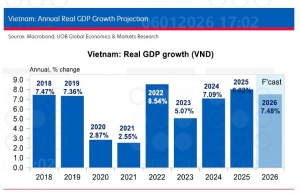 | UOB lifts Vietnam growth outlook to 7.5 per cent for 2026 Vietnam has entered 2026 with solid economic momentum, supported by strong growth last year and a more upbeat outlook from regional economists. |
What the stars mean:
★ Poor ★ ★ Promising ★★★ Good ★★★★ Very good ★★★★★ Exceptional
 Tag:
Tag:
Related Contents





Latest News






More News
- KN Holdings honoured for ESG efforts in Vietnam (October 18, 2026 | 11:00)
- APEA 2026 Vietnam honours 65 outstanding leaders and enterprises (October 17, 2026 | 10:00)
- MEXC highlights AI-driven trading and broader market access at TOKEN2049 (October 17, 2026 | 09:00)
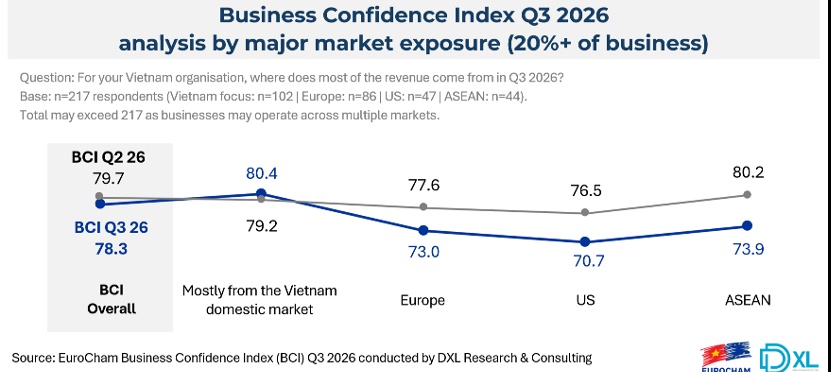
- EuroCham confidence index holds at 78.3 despite operational hurdles (October 16, 2026 | 17:27)
- Shrimp and rice firms face rising standards in export markets (October 16, 2026 | 09:00)
- SCG and Prime Group add value to the ecosystem (October 15, 2026 | 15:55)
- Project readiness key to unlocking green finance (October 15, 2026 | 12:35)
- Sovereign AI and human oversight key to secure digital government (October 15, 2026 | 12:32)
- MEXC Ventures partners with Corelia Academy: Bringing digital asset education closer to Vietnamese students (October 15, 2026 | 09:00)
- Global design expertise meets a more sophisticated Vietnam market (October 15, 2026 | 09:00)









 Mobile Version