
Gold prices swing amid tax debate and import uncertainty

On December 15, DOJI Gold & Gems Group and Saigon Jewelry Company bullion prices remained above $6,272 per tael, about $800 higher than global prices. Over the past half month, bullion prices have fluctuated sharply, peaking at $6,228 per tael on December 1 before retreating to $6,192 on December 3, and then rebounding strongly to hover near historic highs.
At the Vietnam gold market forum held in late November in Hanoi, Vu Hung Son, secretary general of the Vietnam Gold Traders Association, noted that the domestic gold market is undergoing an unusually turbulent phase.
“The queues to buy gold are only the visible part of the problem. Behind them is a prolonged shortage of official raw material supply,” Son said. “For 13 years, gold businesses have had no mechanism to access official sources of raw gold. Without a clear import channel, enterprises have been forced to rely on floating supplies, accepting higher risks simply to maintain production and ensure market availability. This supply constraint has also pushed domestic gold prices higher, while making it increasingly difficult, or impossible, for many consumers to buy.”
In this context, in mid-November the State Bank of Vietnam (SBV) released a draft circular regulating gold positions at credit institutions and opened it for public consultation.
Under the draft, the SBV proposes raising the end-of-day gold position limit for institutions permitted to produce or import-export bullion and raw gold to a maximum of 5 per cent of their Tier-1 capital. Institutions allowed only to trade bullion would be capped at 2 per cent, and no institution would be permitted to hold a net short gold position.
According to the SBV, loosening gold position limits is intended to prepare banks to take on a greater role in the gold supply chain, thereby supplementing the market with official supply. To date, eight commercial banks meet the capital requirements.
Financial expert Tran Duy Phuong said the SBV’s move to widen participation and raise gold position limits to 5 per cent is appropriate, and the additional 20 tonnes would meet essential demand and, more importantly, help ease fears of scarcity.
“A stable supply would keep domestic prices closer to global levels and limit short-term speculation. Investors will see that domestic prices are under control, rather than assuming they can buy at any level and still profit. As supply stabilises and imports normalise, speculative activity will shrink and capital will likely shift into equities or productive sectors,” said Phuong.
Meanwhile, the gold market has paid close attention to the Ministry of Finance’s early-Q4 proposal to impose a 0.1 per cent tax on gold bullion transfers, amid concerns about its fairness, the risk of double taxation, and its actual effectiveness in stabilising the market.
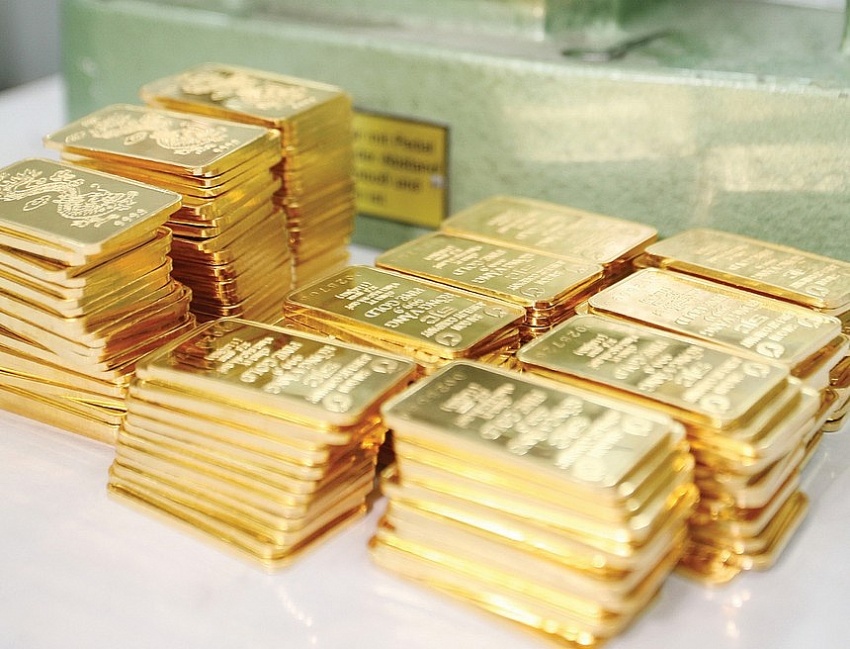 |
Minister of Finance Nguyen Van Thang had previously said personal income tax would apply to each gold bullion transfer at a rate of 0.1 per cent. The effective date would be determined after further assessment.
“The primary objective of this tax policy is not revenue collection,” Thang stated. “It is to influence trading behaviour, curb speculation, and reduce pressure on both the gold and foreign exchange markets. Recent experience shows that when speculation drives the gold market, ordinary citizens bear the heaviest losses due to abnormal price swings. This tax is one of several tools to stabilise the market, and our review confirms it does not result in double taxation.”
Experts emphasise the need to properly understand the nature of the policy. According to Assoc. Prof. Ngo Tri Long, the tax is designed to enhance transparency and oversight, not as a revenue-maximising measure or a burden on consumers.
“A 0.1 per cent tax per sale increases round-trip trading costs by at least 0.2 per cent, adding a barrier on top of bid-ask spreads,” Long said. “It is a modest but effective deterrent to thin-margin speculative trading. International experience with financial transaction taxes shows that small fees often curb short-term speculation more than long-term investment.”
In the context of strong global gold demand and Vietnam’s heightened appetite for bullion, Long sees the tax as a useful gatekeeper.
“Linking the tax to withholding at source and electronic invoicing will create a more complete transaction database, enabling the SBV to regulate supply, conduct intervention sales, and coordinate anti-money laundering and transfer-pricing efforts,” he added. “With a low tax rate, applicable only to bullion, and with withholding and e-invoicing in place, the risk of shifting to the black market is limited. The policy is firm enough to curb speculation but flexible enough to avoid shocking legitimate savers.”
Dr. Nguyen Ngoc Tu, lecturer of Hanoi University of Business and Technology argued that since real estate transactions face a 2 per cent tax, gold could reasonably be taxed at 1-2 per cent, using a withholding-at-source mechanism administered by licensed gold businesses.
“Taxing income from gold trading would reduce speculative incentives, redirecting capital towards production and business instead of hoarding,” said Tu. “If fewer people buy, prices could cool. However, a tax threshold should be introduced, for example, only taxing sales from one tael or more to avoid burdening small household-level sales.”
 | Gold monopoly policy retooling in the works In a landmark move to liberalise its gold market, Vietnam is set to dismantle the state’s long-standing monopoly on gold bullion production and use e-invoices for transactions. |
 | Gold market rejuvenation on horizon Beyond identifying physical gold bars or establishing a gold exchange, fresh proposals have gone further, including the introduction of securities-like accounts at banks and gold trading enterprises. |
 | Gold market embarks on new rebuilding trajectory The State Bank of Vietnam is simultaneously tightening oversight and advancing plans for a national gold exchange, placing banks and businesses to seize opportunities while facing a more transparent and disciplined market. |
 | Global gold exchange models offer roadmap for Vietnamese market Lessons from world-leading gold exchange models in vibrant precious metals markets such as Singapore, Shanghai, and Thailand could provide useful direction for Vietnam as it works to build a modern, transparent gold market aligned with global standards. |
What the stars mean:
★ Poor ★ ★ Promising ★★★ Good ★★★★ Very good ★★★★★ Exceptional
 Tag:
Tag:Latest News




More News
- Vietnam and Switzerland to deepen financial cooperation (October 19, 2026 | 13:24)
- Carbon finance hinges on viable ventures (October 19, 2026 | 09:59)
- AI to transform the future of finance (October 19, 2026 | 09:04)
- Government proposes relaxing IPO conditions (October 19, 2026 | 08:00)
- Citi warns of intensifying competition for capital amid higher rates (October 16, 2026 | 16:54)
- Banks poised for Q3 profit growth amid margin pressure (October 16, 2026 | 16:51)
- Eximbank to strengthen corporate governance structure (October 16, 2026 | 11:32)
- Citi honours 13 banks with 2025 STP Awards (October 15, 2026 | 16:01)
- Green transition requires realistic roadmap (October 14, 2026 | 17:31)
- VIR workshop explores credit policy and carbon market development (October 14, 2026 | 11:22)








 Mobile Version