

Qualcomm sees Vietnam moving beyond manufacturing towards innovation

 |
What does a multi-domain innovation model look like in practice today, and how is Qualcomm evolving its R&D approach to support this?
Technologies such as AI, computing, connectivity, and silicon development are becoming increasingly interconnected. Advances in one area now directly shape performance and capabilities in another, making system-level integration far more important than in previous technology cycles.
This shift is fundamentally reshaping how global R&D organizations operate, including at Qualcomm. Our engineering teams are working across disciplines and geographies to develop technologies as part of integrated platforms rather than isolated components. The focus is no longer just on advancing individual technologies, but on how those technologies come together to deliver performance, power efficiency, scalability, and real-world usability across different industries and devices.
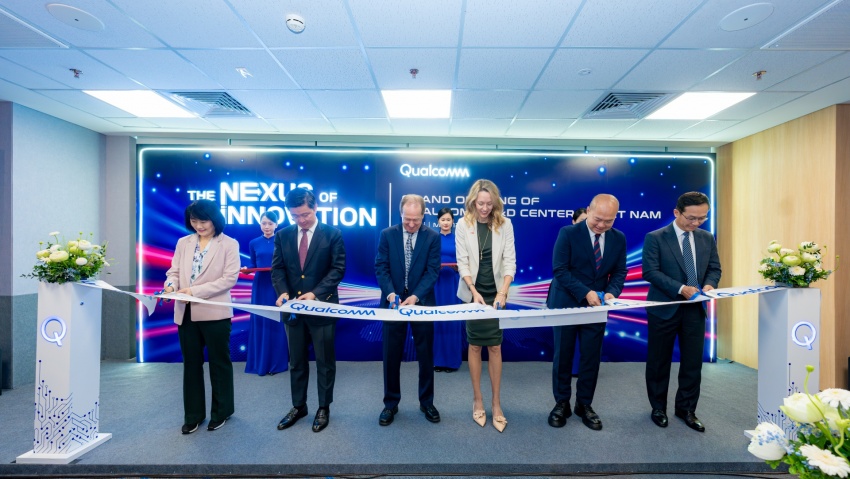
Within this model, Qualcomm’s teams in Vietnam contribute directly to core technology development while collaborating closely with engineering teams across Qualcomm’s global R&D network. Their role spans not only AI research, but also broader areas such as system integration and platform-level innovation across multiple technology domains. The expansion also reflects Qualcomm's long-term hiring focus in Vietnam: we are not building an AI-only team, but are actively expanding engineering capabilities across semiconductors, software, and system solutions. This breadth is intentional. Vietnam's engineering talent pool has matured significantly, and we see real depth across these disciplines — not just in software, but increasingly in hardware and silicon-level thinking.
What are the biggest barriers to scaling innovation from R&D into large-scale global deployment?
The greatest challenge today is no longer the invention of individual technologies, but the ability to optimise, validate, and scale them reliably in real-world environments. As technologies become more interconnected, maintaining consistent performance, quality, reliability, and energy efficiency across large-scale deployments also becomes significantly more complex.
That said, innovation is no longer driven by a single company or technology layer alone. Bringing new technologies to market increasingly requires coordination across the broader ecosystem - including suppliers, device manufacturers, operators, cloud providers, software developers, and industry partners.
From Qualcomm’s perspective, this is why platform-level engineering and long-term ecosystem collaboration have become increasingly important. The ability to scale technologies globally now depends not only on innovation itself, but also on how effectively that innovation can be deployed, adapted, and sustained across real-world environments.
 |
Which sectors do you see as having the strongest potential, and how does Qualcomm plan to drive innovation across them?
At Qualcomm, we do not look at innovation through the lens of individual industries alone. Industries such as telecommunications, automotive, industrial IoT, and digital infrastructure are increasingly being shaped by the same underlying technologies like AI, connectivity, computing, and intelligent edge systems. Because of that, many of the core technologies we develop can be applied across multiple sectors at the same time. The difference usually comes later, at the product and deployment level, where solutions are adapted to the specific needs of a particular industry.
The Hanoi and Ho Chi Minh City teams are part of Qualcomm’s global R&D organisation and contribute to the development of core technologies that feed into our broader technology roadmap. For example, the team here has worked on AI use cases, and the technologies they developed have become part of our AI roadmap, which is then integrated into products we ship globally. The team also works closely with local partners such as Viettel and VNPT to gain a deeper understanding of local requirements and use cases, some of which may be unique to those partners or to the Vietnamese market. They then develop technologies and solutions to address those needs, and over time those contributions can become part of Qualcomm’s broader global technology roadmap.
So across many global markets that we operate, this is how innovation works. On one hand, we pursue innovation based on the technologies we want to develop. On the other hand, we also learn from customer feedback, which can sometimes reveal unique requirements or use cases. That feedback helps shape new solutions, which can eventually become part of the broader global roadmap.
 |
How do you see Vietnam’s role evolving in the global technology value chain, and what role can Qualcomm play in this?
I think Vietnam is definitely moving in the right direction. With the government’s growing focus on areas such as AI, semiconductors, and advanced connectivity, we already see strong momentum in that direction. We are encouraged by the continued efforts to improve the policy environment for innovation, attract global technology investment, and enable more research and development activities in the country. Qualcomm sees growing opportunities for Vietnam not only as a market or manufacturing base, but increasingly as a contributor to global technology development through research, engineering, and localised innovation.
That is also why Qualcomm continues to expand our engineering presence in Vietnam across semiconductors, software, and system-level engineering, alongside AI research. These are not parallel tracks — they are deeply interconnected. Semiconductor work informs what is possible at the software and system level, while insights from AI research and real-world deployments feed back into how we architect silicon and platform solutions. By growing capabilities across all of these areas in Vietnam, we are enabling our teams here to participate in the full innovation cycle — from foundational research through to scalable, globally deployable technology.
From our perspective, this is where collaboration becomes especially important. Through partnerships with local technology companies, universities, startups, and the broader ecosystem, we see opportunities to help accelerate the development of engineering capability and connect Vietnamese innovation more closely with global technology platforms and markets.
Over time, we believe Vietnam has the potential to become not only a place where technology products are built, but also a place where globally relevant technologies and engineering capabilities are created and scaled.
What the stars mean:
★ Poor ★ ★ Promising ★★★ Good ★★★★ Very good ★★★★★ Exceptional
 Tag:
Tag:Related Contents





Latest News




More News
- DSV backs Vietnam's push for more sustainable logistics (August 04, 2026 | 17:10)
- Roche Pharma Vietnam appoints new general manager, reinforcing commitment to Vietnam healthcare (July 23, 2026 | 15:41)
- Constant Energy on Vietnam solar power and policy hurdles (July 22, 2026 | 08:00)
- Key points when drafting a company charter to reduce disputes in Vietnam (July 20, 2026 | 08:00)
- AkzoNobel executive on sustainability as a manufacturing growth driver (July 10, 2026 | 14:53)
- LivWell expands holistic health ecosystem for businesses and communities in Vietnam (July 09, 2026 | 16:43)
- Thai beverage group sees Vietnam as long-term growth partner (July 02, 2026 | 08:30)
- AstraZeneca chief on Vietnam's healthcare financing shift (June 30, 2026 | 16:47)
- Vietnam emerges as one of VistaJet’s fastest-growing markets (June 18, 2026 | 16:21)
- Goldwind Asia chief on driving quality growth in wind sector (June 15, 2026 | 17:54)


Latest News





 Mobile Version