
Diversifying funding sources can ensure sustainability aims


Financial experts and market participants note that although credit growth has remained strong this year, reflecting the economy’s substantial demand for capital, the banking system is now approaching natural limits to further loan expansion.
 |
In an interview with VIR, Nguyen Ba Hung, principal country economist of the Asian Development Bank in Vietnam, said that a major weakness of the Vietnamese market lies in its limited capacity for maturity transformation.
“Specifically, short-term funds are not being channelled towards sectors with genuine long-term capital needs, while long-term funds lack stable absorption mechanisms,” Hung said. “As a result, the economy remains heavily dependent on the banking system, which is the only channel currently capable of flexibly balancing short-, medium-, and long-term funding needs, even though its medium- and long-term capacity is also constrained.”
This prevents the capital market from fully performing its role as a provider of credit to share the burden now placed almost entirely on banks, Hung added.
Regarding the mobilisation of private capital through the capital market to support sustainable development objectives, Hung explained that global financial systems typically operate around three core components.
The first is the equity market, where corporate shares are issued and traded. The second is the debt market, which includes both the bond market and the banking system. The third is the money market, where instruments with maturities of under one year are traded, serving as the key source of liquidity for the entire system.
“At present, Vietnam still lacks significant diversity across these components. Developing the financial market, in essence, means building a complete ecosystem,” Hung noted.
“This is not only the three pillars of the market structure but also the auxiliary services that enable efficient functioning, such as financial advisory, credit rating, brokerage, investment funds, and a broad spectrum of investment products for both institutional and retail investors. International experience shows that the more diversified the ecosystem, the greater the market’s ability to mobilise large-scale private capital at an optimal cost of funding.”
Regarding other capital channels for sustainable development, Dr. Nguyen Quoc Hung, vice chairman and general secretary of the Vietnam Banks Association (VNBA), shared that although Vietnam’s green bond market has taken shape, its scale remains modest, making up only 2 per cent of total corporate bonds.
“For Vietnam’s green bond market to grow meaningfully, the country needs a more synchronised support framework, one that helps enterprises correctly interpret green standards, reduces compliance costs, and investors build trust through transparent, consistent disclosure systems,” he added.
Hung commented that international investors now consider Vietnam’s green bonds a promising asset class, driven by both returns and sustainable development value.
“This presents a major opportunity for Vietnam to mobilise capital while asserting its standing in the global green finance ecosystem. The VNBA is committed to supporting issuers through capacity-building, process standardisation, and effective engagement with international investors,” said VNBA’s representatives.
In Vietnam, the equity and corporate bond markets are undergoing significant restructuring. The 2019 Securities Law and subsequent guiding decrees have gradually standardised issuance activities, strengthened disclosure requirements, and enhanced regulatory oversight.
According to the Ministry of Finance and the State Securities Commission, these adjustments help reinforce market discipline, which is an essential condition for developing long-term capital channels.
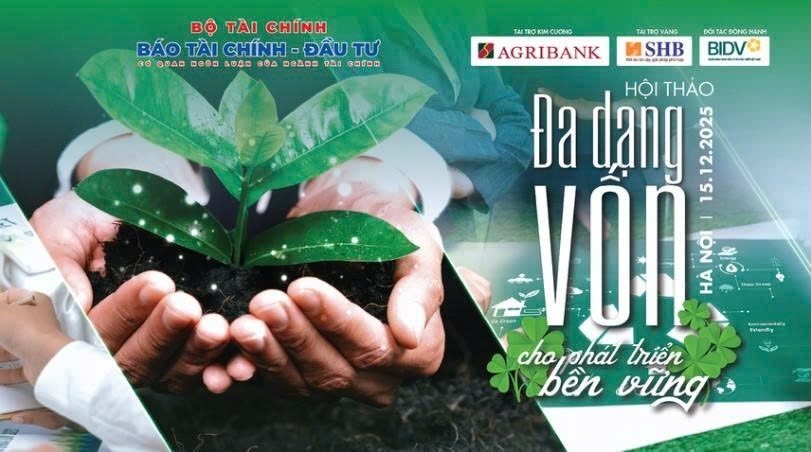
| Vietnam is entering a phase of defining a new growth model, one in which rapid growth must go hand in hand with sustainability. Traditional growth drivers continue to be revitalised, while new drivers such as the digital economy, green economy, and circular economy are becoming increasingly central. To achieve these goals, mobilising diverse financial resources has become an urgent priority. Against this backdrop, Vietnam Investment Review is organising a conference called Expanding Green Finance for Sustainable Growth, aimed at providing a comprehensive overview of capital demand, funding trends, and policy solutions in the coming period. Time: 8:30-11:30am, December 15 Venue: Vietnam Investment Review, 47 Quan Thanh street, Hanoi The event is organised with guidance from the Ministry of Finance and the State Bank of Vietnam, in partnership with Agribank, SHB, BIDV, and will feature leaders of domestic and international financial institutions, experts, and industry stakeholders. |
What the stars mean:
★ Poor ★ ★ Promising ★★★ Good ★★★★ Very good ★★★★★ Exceptional
 Tag:
Tag:Latest News





More News
- Cashless payments hit 28 times GDP in 2025 (February 04, 2026 | 18:09)
- SSIAM and DBJ launch Japan Vietnam Capital Fund (February 04, 2026 | 15:57)
- Banks target stronger profits, credit growth in 2026 (February 04, 2026 | 15:43)
- Vietnam on path to investment-grade rating (February 03, 2026 | 13:07)
- Consumer finance sector posts sharp profit growth (February 03, 2026 | 13:05)
- Insurance market building the next chapter of protection (February 02, 2026 | 11:16)
- NAB Innovation Centre underscores Vietnam’s appeal for tech investment (January 30, 2026 | 11:16)
- Vietnam strengthens public debt management with World Bank and IMF (January 30, 2026 | 11:00)
- Corporate bond market poised for stronger growth cycle (January 28, 2026 | 17:13)
- Vietnam's IPO market on recovery trajectory (January 28, 2026 | 17:04)









 Mobile Version