
Concrete problems for firms


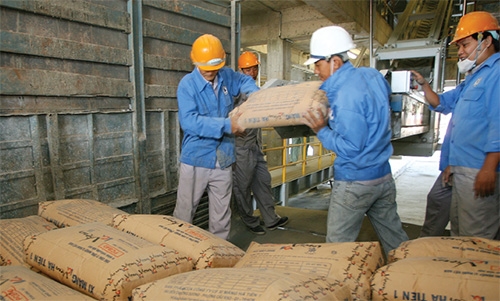
The construction industry downturn has slapped cement firms in the facePhoto: Le Toan
The Ministry of Construction (MoC) reported cement consumption reached 11 million tonnes in the first quarter of this year, roughly 95 per cent in comparison with the same period in 2012. However, by the end of March 2013, the industry’s inventory was 3.1 million tonnes, including 2.3 million tonnes of clinker and 850,000 tonnes of cement.
“2012 saw cement firms going to the verge of bankruptcy and signs of improvements have yet to be on the horizon.
Meanwhile, most cement exporters said export was only a stopgap solution in the current context,” said Tran Van Huynh, chairman of Vietnam Association for Building Materials (ABM).
Last year, the local cement industry’s total designed capacity reached 67 million tonnes. But cement plants as a whole operated at a much slower pace with domestic consumption at 49.1 million tonnes, according to the MoC.
Quan Trong Dan, deputy director of Holcim Vietnam Company, said the prospects for 2013 were not looking bright either.
Difficulties were also forecast by Hoang Manh Truong, chairman of Vissai Cement Group, known as one of the biggest cement makers in Vietnam. “In 2013, even if Vissai put consistent efforts into the export market and won over major real estate projects, the group’s consumption is forecast to increase by only 5 per cent.”
In the latest move, the prime minister approved the MoC’s proposal to scrap nine domestic cement plant projects from the nation’s cement industry development strategy during 2011-2020, with orientations towards 2030, as fearing the oversupply could result in market chaos.
These scrapped projects include Ha Tien-Kien Giang, Truong Son-Ro Li, Hop Son, Ngoc Ha, Thanh Truong, Son Duong, Quang Minh and Cao Bang projects, each of which was supposed to produce less than 2,500 tonnes of clinker per day. The decision came as under ABM calculations cement consumption in the domestic market would drop 14-15 per cent during 2011-2013 against the forecast level in the strategy.
ABM predicted by 2013 Vietnam would need around 60-65 million tonnes of cement to feed the domestic market against the forecast production output of 75-76 million tonnes in the strategy.
“Removing low capacity and ineffective cement projects from the nation’s cement industry development strategy is indispensable. It would bring significant changes and greener production practices into Vietnam’s cement industry as well as save power consumed in cement production, amid Vietnam’s grave shortages of energy,” said Vu Ngoc Quy, deputy director of Taiwan’s Cement Chinfon Company, one of the biggest cement suppliers in Vietnam.
Huynh said that domestic cement makers had to speed up their restructuring to increase their competition.
The current time has proven hard even to market leaders like state conglomerate Vicem, which consists of eight member companies and controls over 33 per cent of the domestic market countrywide. This year, Vicem targeted to earn the revenue of $1.4 billion, up from last year’s figure of $1.3 billion.
What the stars mean:
★ Poor ★ ★ Promising ★★★ Good ★★★★ Very good ★★★★★ Exceptional
Latest News


More News
- Hermes joins Long Thanh cargo terminal development (February 04, 2026 | 15:59)
- SCG enhances production and distribution in Vietnam (February 04, 2026 | 08:00)
- UNIVACCO strengthens Asia expansion with Vietnam facility (February 03, 2026 | 08:00)
- Cai Mep Ha Port project wins approval with $1.95bn investment (February 02, 2026 | 16:17)
- Repositioning Vietnam in Asia’s manufacturing race (February 02, 2026 | 16:00)
- Manufacturing growth remains solid in early 2026 (February 02, 2026 | 15:28)
- Navigating venture capital trends across the continent (February 02, 2026 | 14:00)
- Motivations to achieve high growth (February 02, 2026 | 11:00)
- Capacity and regulations among British areas of expertise in IFCs (February 02, 2026 | 09:09)
- Transition underway in German investment across Vietnam (February 02, 2026 | 08:00)









 Mobile Version